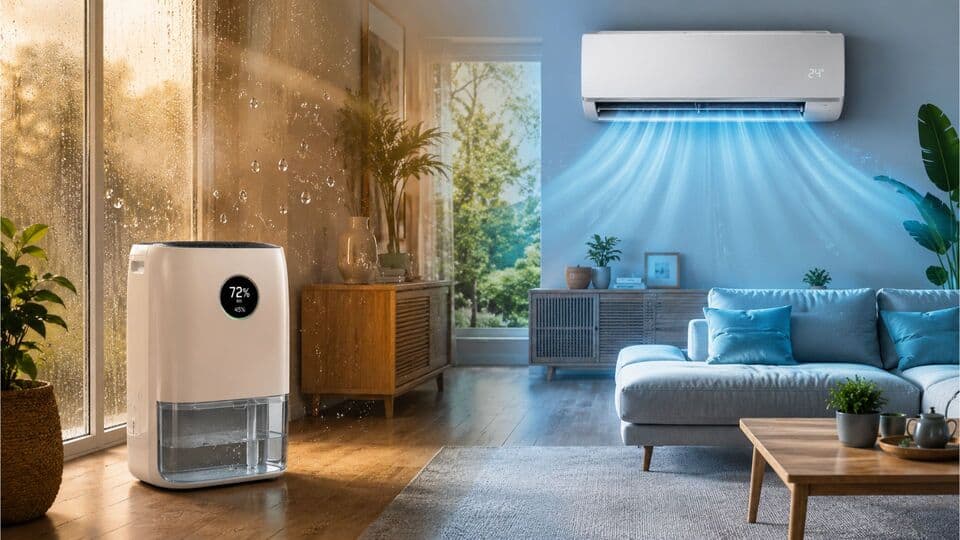
Hot and humid summer weather can make your home feel warmer and more uncomfortable than it actually is. Both dehumidifiers and air conditioners can improve indoor comfort, but they work in different ways. So, when comparing a Dehumidifier vs Air conditioner, which one is the better choice for your home?
A dehumidifier removes excess moisture from the air without actively cooling the room. It can make a damp space feel more comfortable while helping prevent mold, mildew, and moisture damage. An air conditioner, on the other hand, lowers both the room temperature and humidity level.
Each appliance has its own advantages, disadvantages, and ideal uses. In this detailed Dehumidifier vs. Air conditioner comparison, we will explain how both devices work, their benefits, their limitations, and which one you should choose for your needs.
What Is a Dehumidifier?
A dehumidifier is an appliance designed to remove excess moisture from indoor air. It is especially useful in damp rooms, basements, laundry areas, and homes located in humid climates.
However, choosing a dehumidifier should depend on more than price alone. You should consider your indoor humidity level, room temperature, room size, and whether you also need active cooling.
How Does a Dehumidifier Work?
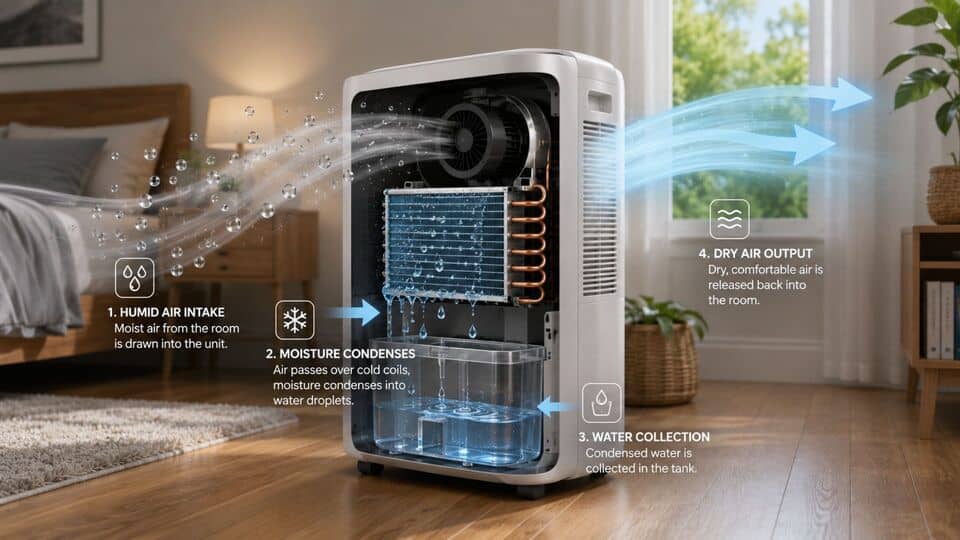
A dehumidifier pulls warm, moist air into the unit with a fan. The air then passes over a set of cold coils. As the air cools, its moisture condenses into water droplets, much like water forming on the outside of a cold glass.
The collected water flows into a removable tank or drains through a connected hose. The appliance then passes the drier air over warmer coils before releasing it back into the room.
Because of this process, a standard dehumidifier may release air that feels slightly warmer than the surrounding air. Therefore, it reduces humidity but does not work as an air-cooling appliance.
Benefits of Using a Dehumidifier
A dehumidifier can improve indoor comfort and protect your home from moisture-related problems. Its main benefits include the following:
- Reduces excess humidity: A dehumidifier removes water vapor from the air and helps maintain a more comfortable indoor humidity level.
- Helps prevent mold and mildew: Mold grows more easily in damp environments. Lowering humidity can make your home less suitable for mold growth.
- Protects wooden furniture: Excess moisture can cause wood to swell, warp, rot, or develop mold over time.
- Protects walls and ceilings: A dehumidifier can reduce condensation and dampness that may damage paint, plaster, wallpaper, and ceilings.
- Protects artwork and photographs: High humidity may cause paper, photographs, paintings, and frames to deteriorate.
- Reduces musty odors: Damp rooms often develop unpleasant smells. Removing excess moisture can make the space smell fresher.
- Creates a less favorable environment for dust mites: Dust mites thrive in humid conditions, so controlling humidity may help reduce their presence.
- Improves comfort for some allergy sufferers: Reducing mold and dust mites may help people who are sensitive to these common indoor allergens.
- Helps clothes dry faster: A dehumidifier can be useful in laundry rooms or indoor drying areas by drawing moisture from the air.
Disadvantages of Using a Dehumidifier
Although dehumidifiers offer several benefits, they also have some limitations. Consider the following disadvantages before purchasing one:
- It does not cool the room: A dehumidifier can make humid air feel more comfortable, but it does not lower the actual room temperature.
- Some models can be noisy: The fan and compressor may produce noticeable sound, especially when the unit runs at a high setting.
- Performance can decrease in cold rooms: Standard refrigerant dehumidifiers may become less effective at low temperatures because frost can form on the coils.
- It uses electricity: Running a dehumidifier for long periods will increase your energy consumption.
- The water tank requires attention: Unless you connect a continuous drainage hose, you will need to empty the tank regularly.
- Doors and windows should remain closed: Leaving them open allows more humid outdoor air to enter, making the appliance work harder.
- Too much dehumidification can dry the air: Extremely low humidity may cause dry skin, throat irritation, and discomfort.
When Should You Choose a Dehumidifier?
A dehumidifier is a suitable choice when excess moisture is the main problem, but the room temperature is already comfortable.
For many homes, an indoor relative humidity level of approximately 30% to 50% is considered comfortable. If your humidity level frequently stays above 50%, a dehumidifier may help create a healthier and more comfortable environment.
You may also benefit from a dehumidifier if you notice condensation on windows, damp walls, musty smells, mold spots, peeling paint, or moisture collecting in a basement or laundry room.
People experience humidity differently. Even when a humidity meter does not show an extremely high reading, you may still find the air sticky or uncomfortable. In that situation, moderate dehumidification may improve comfort.
A dehumidifier is also worth considering if you own valuable wooden furniture, musical instruments, books, paintings, photographs, or other belongings that may be damaged by prolonged exposure to moisture.
What Is an Air Conditioner?
An air conditioner is primarily designed to cool indoor spaces. During the cooling process, it also removes some moisture from the air. This makes an AC useful when your room is both hot and humid.
Air conditioners are available in several forms, including window units, split systems, portable units, and central air-conditioning systems. The best option depends on the size of your space, your budget, and your cooling requirements.
How Does an Air Conditioner Work?
An air conditioner draws warm indoor air into the unit and passes it over a cold evaporator coil containing refrigerant. The refrigerant absorbs heat from the indoor air, while moisture condenses on the cold coil.
The cooled and partially dehumidified air is then circulated back into the room. Meanwhile, the absorbed heat is transferred outdoors through the condenser portion of the system.
The moisture collected during cooling usually drains outside through a pipe or drain pan. Therefore, an air conditioner reduces humidity as a natural part of the cooling process.
Advantages of Air Conditioners
An air conditioner provides temperature control as well as some humidity reduction. Its main advantages include the following:
- Cools indoor spaces: An AC can lower the temperature and provide relief during hot weather.
- Reduces humidity while cooling: Moisture condenses on the evaporator coil, helping the room feel less sticky.
- Maintains a selected temperature: Most air conditioners allow you to set a target temperature through a thermostat.
- Can cool larger spaces: A correctly sized system can cool bedrooms, living rooms, offices, or an entire house.
- Filters circulating air: Air-conditioner filters can capture dust and some airborne particles, depending on the filter quality.
- Offers convenient controls: Many modern units support remote controls, timers, sleep modes, mobile applications, and smart-home integration.
- Can provide heating: Some inverter and heat-pump air conditioners can both cool and heat a room.
- Improves sleep during hot weather: Maintaining a comfortable bedroom temperature can make sleeping easier in summer.
Disadvantages of Air Conditioners
Air conditioners are effective, but they are generally more expensive to purchase and operate than dehumidifiers. Their main disadvantages include the following:
- Higher purchase and installation costs: Split and central air conditioners often require professional installation.
- Higher energy consumption: Cooling a room usually requires more electricity than removing moisture alone.
- Regular maintenance is necessary: Filters, coils, drain lines, and outdoor units require cleaning and inspection.
- Refrigerants can affect the environment: Refrigerant leaks may contribute to environmental harm, although newer systems often use refrigerants with a lower environmental impact.
- It may make the air feel too dry: Long periods of cooling can cause dry skin, eye irritation, or throat discomfort for some people.
- Incorrect sizing can reduce performance: An oversized AC may cool the room too quickly without removing enough humidity, while an undersized unit may run continuously.
- Some units are noisy: Window and portable air conditioners can be louder than many split systems.
When Should You Choose an Air Conditioner?
An air conditioner is the better option when high temperature is your main concern. If your room feels hot as well as humid, an AC can solve both problems at the same time.
Air conditioners are especially useful in climates where summer temperatures remain high for long periods. Unlike a dehumidifier, an AC actively removes heat from the room and transfers it outdoors.
An air conditioner can also reduce indoor humidity while it is cooling. However, its ability to control moisture depends on the unit size, operating time, cooling demand, and indoor conditions.
You should also consider an air conditioner if you need precise temperature control in a bedroom, office, living room, or other frequently used space.
Budget is another important factor. An air conditioner usually costs more to purchase, install, maintain, and operate. However, the additional expense may be worthwhile if you need both cooling and humidity reduction.
Dehumidifier vs Air Conditioner: Detailed Comparison
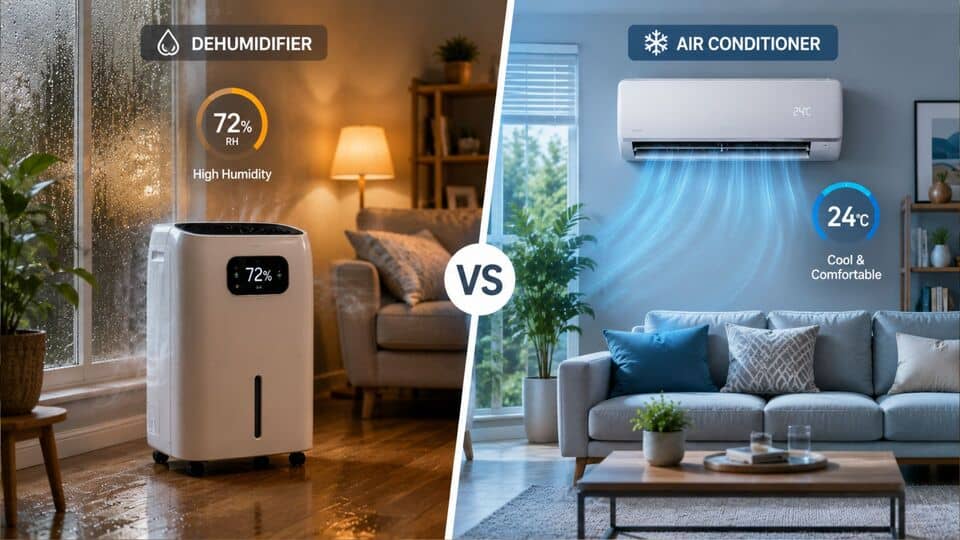
Both appliances can remove moisture from indoor air, but they are designed for different purposes. A dehumidifier focuses on humidity control, while an air conditioner primarily focuses on temperature control.
Here is a closer look at the most important differences between a dehumidifier and an air conditioner.
Primary Function
The main function of a dehumidifier is to reduce the amount of moisture in the air. It collects condensed water and releases drier air back into the room.
The primary function of an air conditioner is to remove heat from an indoor space. It also removes some moisture as part of the cooling process.
Therefore, choose a dehumidifier for dampness and an air conditioner for heat. When both heat and humidity are problems, an air conditioner is usually the more complete solution.
Cooling Capacity
An air conditioner actively cools a room by transferring heat outdoors. A properly sized unit can maintain a comfortable indoor temperature even during hot weather.
A dehumidifier does not provide active cooling. Removing moisture may make the room feel less sticky, but the unit itself releases a small amount of heat while operating. As a result, the room temperature may remain the same or rise slightly.
Humidity Control
A dehumidifier provides more direct and consistent humidity control. Most models allow you to select a target humidity level using a built-in humidistat.
An air conditioner removes moisture only while its cooling cycle is running. If the room reaches the selected temperature quickly, the AC may switch off before removing enough humidity.
For a cool but damp room, a dehumidifier usually offers better moisture control. For a hot and humid room, an air conditioner may be more practical.
Energy Consumption
A dehumidifier generally consumes less electricity than an air conditioner because it does not need to cool an entire room. However, the actual energy use depends on the appliance capacity, efficiency rating, operating time, room size, temperature, and humidity level.
Air conditioners usually require more power because they operate a refrigeration system that continuously transfers heat from indoors to outdoors.
Energy consumption also varies significantly among window, portable, split, inverter, and central air-conditioning systems. Checking the energy-efficiency rating is more reliable than comparing wattage alone.
Purchase and Operating Cost
Dehumidifiers are usually less expensive to purchase and do not require complicated installation. Portable models can often be used immediately after setup.
Air conditioners normally cost more, particularly when professional installation, electrical work, mounting equipment, or ductwork is required. They may also have higher maintenance and electricity costs.
However, paying more for an air conditioner may make sense when you need effective cooling rather than humidity control alone.
Size and Portability
Many dehumidifiers are compact and portable. They often include handles or wheels, allowing you to move them between rooms when necessary.
Window, split, and central air conditioners are generally fixed in one location. Portable air conditioners are available, but they require an exhaust hose and are often bulkier than portable dehumidifiers.
Noise Level
Both appliances contain fans, and many models also contain compressors. Therefore, either appliance may produce noise while operating.
Noise levels depend more on the model and design than on the appliance category. A quiet split air conditioner may produce less indoor noise than a powerful portable dehumidifier, while window and portable AC units are often more noticeable.
Before purchasing either device for a bedroom or office, check its noise rating in decibels.
Maintenance Requirements
A dehumidifier usually requires regular filter cleaning and water-tank emptying. Units connected to a continuous drain require less daily attention, but the drain hose should still be checked occasionally.
An air conditioner requires filter cleaning, coil maintenance, drain-line inspection, and occasional professional servicing. Outdoor units must also remain clear of dust, leaves, and other obstructions.
Dehumidifier vs Air Conditioner Comparison Table
The following table summarizes the main differences between a dehumidifier and an air conditioner:
| Criteria | Dehumidifier | Air Conditioner |
|---|---|---|
| Primary Function | Removes excess moisture from the air | Cools the air and removes some moisture |
| Cooling Capability | Does not actively cool the room | Actively lowers the room temperature |
| Humidity Control | Provides direct and precise humidity control | Reduces humidity only while cooling |
| Best Use | Cool or comfortable rooms with excess humidity | Hot rooms that also feel humid |
| Energy Consumption | Usually lower than an air conditioner | Usually higher because it actively cools the room |
| Purchase Cost | Generally more affordable | Generally more expensive |
| Installation | Usually simple and does not require professional installation | Window, split, and central systems may require installation |
| Size and Portability | Many compact and portable models are available | Most models are fixed; portable options are bulkier |
| Water Management | Requires tank emptying or a drainage hose | Condensed water normally drains automatically |
| Noise Level | Varies by model; compressor units may be noticeable | Varies by type; portable and window units may be noisy |
| Maintenance | Filter cleaning and water-tank or drain maintenance | Filter, coil, drain, and system maintenance |
Can You Use a Dehumidifier and Air Conditioner Together?
Yes, you can use a dehumidifier and an air conditioner together, but doing so is not always necessary.
An air conditioner already removes some moisture while cooling. However, during extremely humid weather, it may reach the desired temperature before reducing humidity to a comfortable level. A separate dehumidifier can then provide additional moisture control.
Using both appliances may also help in basements or other damp spaces where the temperature is not high enough to keep the air conditioner running for long periods.
Keep in mind that both appliances use electricity and release heat during operation. A dehumidifier may slightly increase the cooling load on your AC, so you should use both only when the additional humidity control is genuinely needed.
Does a Dehumidifier Make a Room Feel Cooler?
A dehumidifier may make a humid room feel more comfortable because lower humidity allows sweat to evaporate more easily from your skin. However, it does not actually cool the room.
In fact, most refrigerant dehumidifiers release a small amount of heat while operating. Therefore, the measured room temperature may rise slightly even though the air feels less sticky.
If your main goal is to lower the temperature, you need an air conditioner. If your room is already cool but feels damp, a dehumidifier is the better choice.
Which Is Better for Mold: Dehumidifier or Air Conditioner?
A dehumidifier is usually better for controlling the damp conditions that encourage mold growth. It allows you to maintain a selected humidity level even when the room does not need cooling.
An air conditioner can also help reduce mold risk by lowering humidity while it runs. However, it may not provide enough moisture control in a cool, damp room or during mild weather.
Neither appliance can remove an existing mold infestation by itself. Visible mold should be cleaned safely, and the source of moisture—such as a plumbing leak, roof leak, condensation problem, or poor ventilation—must be repaired.
How to Choose Between a Dehumidifier and an Air Conditioner
Before buying either appliance, identify the main cause of your discomfort. Consider the following situations:
- Choose a dehumidifier if the room feels damp, smells musty, or shows signs of condensation, but the temperature is already comfortable.
- Choose an air conditioner if the room is hot and you need active cooling.
- Choose an air conditioner if both heat and humidity are making the room uncomfortable.
- Consider using both if an air conditioner cools the room but cannot maintain a comfortable humidity level.
- Use a hygrometer to measure humidity instead of relying only on how the room feels.
- Select the correct capacity based on the room size, moisture level, climate, and manufacturer recommendations.
Frequently Asked Questions
Is a Dehumidifier Cheaper to Run Than an Air Conditioner?
In most cases, a dehumidifier is cheaper to operate because it uses less power than an air conditioner. However, actual running costs depend on the appliance size, efficiency, electricity rate, and number of operating hours.
Can a Dehumidifier Replace an Air Conditioner?
A dehumidifier cannot replace an air conditioner when the room needs active cooling. It may make humid air feel more comfortable, but it will not lower the actual temperature.
Can an Air Conditioner Replace a Dehumidifier?
An air conditioner may provide enough humidity reduction in a hot room. However, it may not replace a dedicated dehumidifier in cool, damp areas or in rooms that need humidity control without additional cooling.
Which Appliance Is Better for a Basement?
A dehumidifier is usually better for a cool or moderately warm basement because basements often experience dampness without requiring significant cooling. A basement that becomes very hot may benefit from both cooling and dehumidification.
What Humidity Level Should I Maintain Indoors?
Many people find an indoor relative humidity level between approximately 30% and 50% comfortable. Keeping humidity below 50% may also help discourage mold and dust mites. However, the ideal setting can vary depending on the climate and season.
Final Verdict: Dehumidifier vs Air Conditioner
The right choice in the Dehumidifier vs Air conditioner debate depends on the problem you need to solve.
Choose a dehumidifier when excess moisture, condensation, mold risk, or musty odors are your main concerns. It is generally more affordable, portable, and energy-efficient than an air conditioner, but it will not cool the room.
Choose an air conditioner when your room is hot and needs active cooling. An AC can lower the temperature and reduce humidity at the same time, making it the better all-in-one solution for hot and humid weather.
You do not need to spend more money on an air conditioner when moisture is your only problem. However, when you need both cooling and humidity reduction, a properly sized air conditioner is usually the more practical choice.
Before making your final decision, measure the room temperature and humidity level, consider the room size, and compare the purchase price, operating cost, noise level, and maintenance requirements of each appliance.