Technology has advanced significantly. It allows you to control room temperature and air quality. You can even control humidity levels by increasing or decreasing the amount of moisture in the air. But how do you know whether your room needs a dehumidifier or a humidifier? It’s better to learn about them properly before making a decision.
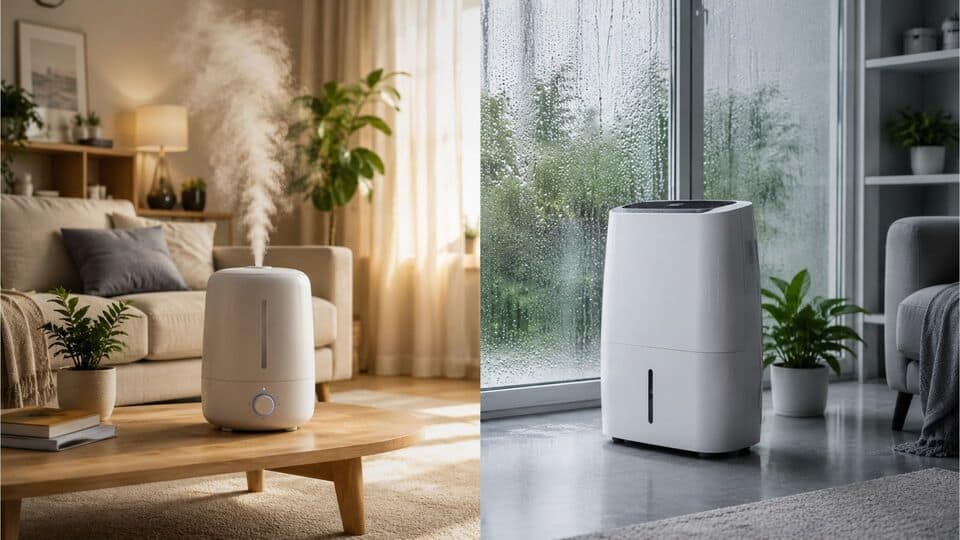
Humidifiers add moisture to the air, which is helpful in dry climates and can protect you from dry skin and chapped lips. In contrast, dehumidifiers lower humidity levels and protect your walls and furniture from damage during the summer or when humidity levels are high.
As you can see, both humidifiers and dehumidifiers are appliances that allow you to control moisture levels. However, they work in opposite ways. So, which one do you need? Let us help you decide.
Benefits of Using a Dehumidifier vs. Humidifier
By now, you have probably realized that there are several differences between dehumidifiers and humidifiers. Both appliances offer different benefits. Learning about these benefits will help you understand which one you need.
- For Allergies
One of the major benefits of using a dehumidifier in a room is that it can help dry excessively moist environments. Humid environments often contain allergens such as dust mites and mold, which can cause problems for people with allergies.
Humidifiers, on the other hand, can increase moisture levels in dry air and may make breathing more comfortable. So, both humidifiers and dehumidifiers can be helpful for allergies under different conditions. If you have allergies, you need to identify which weather conditions or humidity levels cause complications for you and make a decision based on that.
- For Asthma
If you have asthma and are wondering whether a dehumidifier or humidifier will be better for your health, let us help.
Dehumidifiers can be helpful for individuals with asthma triggered by excess moisture and related allergens, such as mold, dust mites, and mildew. Dehumidifiers can reduce conditions that encourage these allergens and improve indoor air quality by removing excess moisture from the air.
In contrast, a humidifier can be helpful for individuals whose asthma symptoms are aggravated by dry air by increasing the amount of moisture in the air.
Both humidifiers and dehumidifiers can be helpful for asthma under different conditions. So, which one should you choose? You should consider your asthma triggers and the humidity level in your home.
- For Mold
You have already learned that dehumidifiers can help you deal with mold problems. But what about humidifiers? Well, humidifiers get a minus point in this regard. Since excess moisture encourages mold growth, a humidifier may only add to the problem. Therefore, a dehumidifier is the better option when dealing with excess humidity and mold growth.
When to Use a Dehumidifier or Humidifier?
You have learned about the benefits of using a humidifier and a dehumidifier. You may be able to make your decision now. But if you are still confused, don’t worry. Let’s make it simpler.
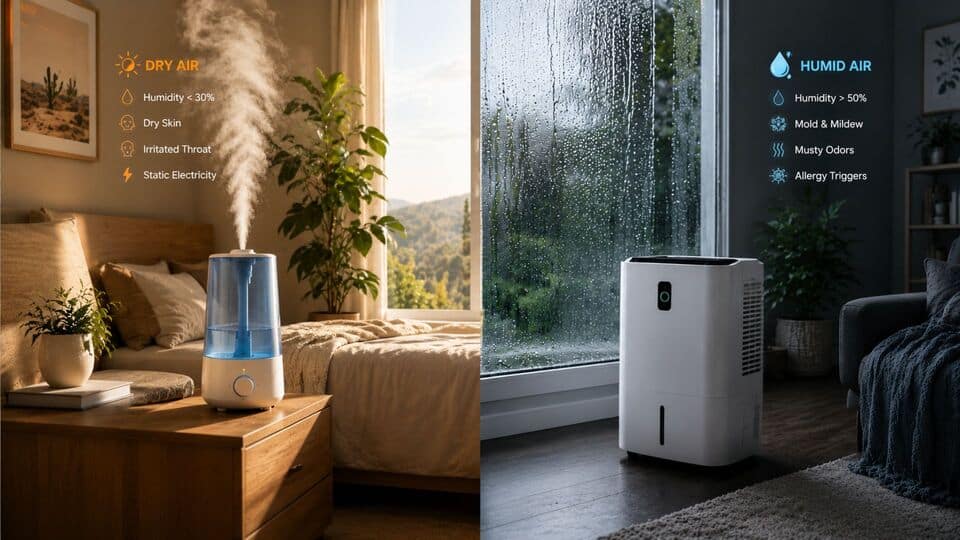
You need to use a dehumidifier when the weather is damp and humid. Dehumidifiers are usually recommended when the humidity level is above 50%. Using a dehumidifier in such conditions can help protect you from the following problems:
- Mold growth, which can damage your walls and furniture
- Musty odors, which can be unpleasant
- Condensation, which can lead to water damage and the growth of mold and mildew
- Higher energy costs, as humid air can make a room feel hotter and may cause you to use the AC more frequently
As you can see, using a dehumidifier provides several benefits in a humid climate. But what if the climate or weather is not humid but dry? In that case, you may need to use a humidifier. You should consider using a humidifier under the following conditions:
- In dry climates: A humidifier can help make the air more comfortable and alleviate symptoms such as dry skin, chapped lips, and respiratory irritation.
- During the winter: A humidifier can add moisture to the air and help protect you from dry skin and chapped lips.
- For dry air-related complications: Some people experience allergy or asthma symptoms due to dry air. If you face the same problem, a humidifier may help.
How to Measure Humidity Levels in Your Home?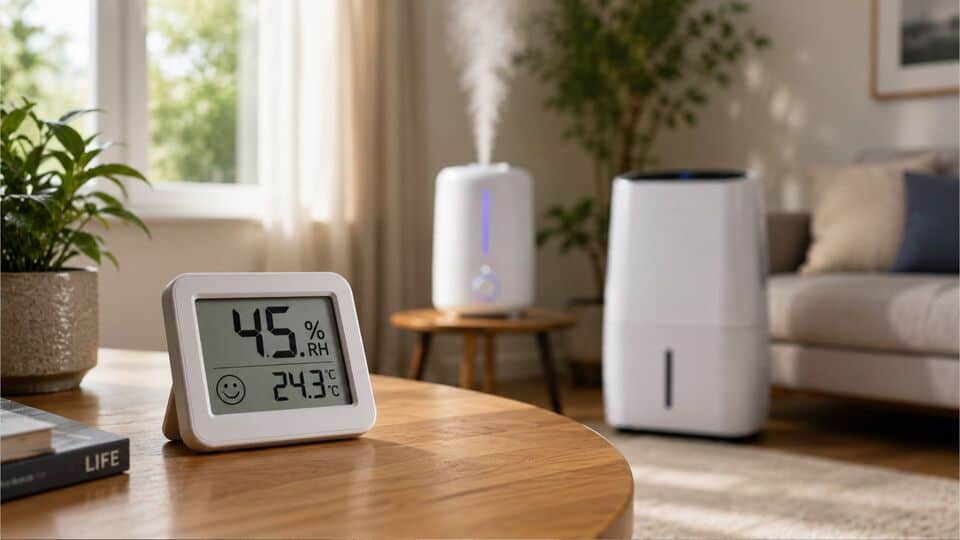
When deciding between a humidifier and a dehumidifier, knowing the humidity level is important. Let’s look at some easy methods for measuring the humidity level in your home.
- Using a Hygrometer
This is the easiest way to measure your room’s humidity level. It can give you a highly accurate measurement, and the process is very simple. You just have to place it inside your room and check the reading after a few hours. Ta-da! Now you know the humidity level in your home. Easy.
- Wet and Dry Bulb Thermometer
Another effective method is to use wet- and dry-bulb thermometers. You will need a few materials, but this method can provide an accurate result. You will need two regular glass thermometers to compare the wet- and dry-bulb temperature readings.
To conduct the humidity test, leave one thermometer uncovered to act as the dry bulb. Then, using a rubber band, wrap a wet cotton ball around the bottom of the second thermometer. This will act as the wet bulb. To prevent the water temperature from distorting the results, moisten the cotton ball with room-temperature water.
- The Ice Cube Method
Well, why spend money on a hygrometer if you are not going to use it often? Here is a very simple way to get a rough idea of the humidity level without spending any money. You only need a glass of water and two or three ice cubes. How is this going to tell you the result? Follow these instructions.
First, take a glass of water, add two or three ice cubes, and leave the room. That’s it. After three to five minutes, return to the room and observe the glass. Can you see condensation forming or dripping on the outside of the glass?
- If yes, the humidity level may be high.
- If not, the humidity level may be low.
Here is one thing you should remember: Do not put the glass in the kitchen. You should also leave the room after placing the glass.
How to Determine if You Need a Humidifier or Dehumidifier?
You have learned about the methods for measuring the humidity level in your home. Now, you can make your decision more easily.
The normal indoor humidity range for a home is generally 30% to 50%. When your home has a humidity level above 50%, the air may become too humid.
In that case, you should use a dehumidifier. It can help protect you from the various problems discussed earlier. In contrast, you may need a humidifier if the humidity level is below 30%.
Tips for Maintaining Optimal Humidity Levels in Your Home
High humidity levels can make the air in your room very uncomfortable. The same is true when the air is too dry. You need to maintain an optimal humidity level for comfort. Here are some tips that can help you.
- When the Air Is Dry
You can always use a humidifier in a dry climate. However, taking some additional steps can also provide several benefits:
- Bring in some houseplants: They release water vapor from their leaves and can help increase moisture in the air. But don’t forget to water them regularly.
- Boil water or cook on the stovetop. This can release steam into the air and increase humidity.
- Hang your laundry to dry indoors. The moisture will evaporate into the air.
- Do not drain the bathwater immediately. While the water is still warm, leaving it in the tub for a while may allow some moisture to evaporate into the air.
- When the Air Is Humid
There are many ways to lower humidity levels. Here are some of the most effective ones:
- Turning up the air conditioning
- Using a ventilation fan
- Moving your houseplants outside
- Opening the windows when outdoor humidity is lower
- Installing a vapor barrier
Final Words
Both humidifiers and dehumidifiers offer benefits, depending on the climate and humidity conditions. You may need both of them at different times of the year, or you may only need one. Hopefully, you have now found the answer to whether you need a humidifier or a dehumidifier.
To summarize, you may need a humidifier during winter or dry weather to increase moisture levels. You may need a dehumidifier during summer or humid weather to lower humidity levels.
FAQs
- How do I know if I need a dehumidifier?
It is easy to determine whether you need a dehumidifier. Use a hygrometer to measure the humidity level in your home. If it is above 50%, you may need a dehumidifier.
- Is a humidifier or dehumidifier better for sleep?
If the humidity level is too high or too low, it can affect your sleep. If the air is too humid, a dehumidifier may be better for sleep. If the air is too dry, a humidifier may be the better option.
- How do I know if my home is too humid or too dry?
There are several ways to determine whether your home is too humid or too dry. Using a hygrometer is the easiest and most effective method. You can also try the ice cube method or use wet- and dry-bulb thermometers.
- Can using a humidifier or dehumidifier help with allergies?
Yes, both humidifiers and dehumidifiers can help with allergies under certain conditions. It depends on the person’s allergy triggers, as both excessively dry and overly humid conditions can contribute to allergy symptoms.