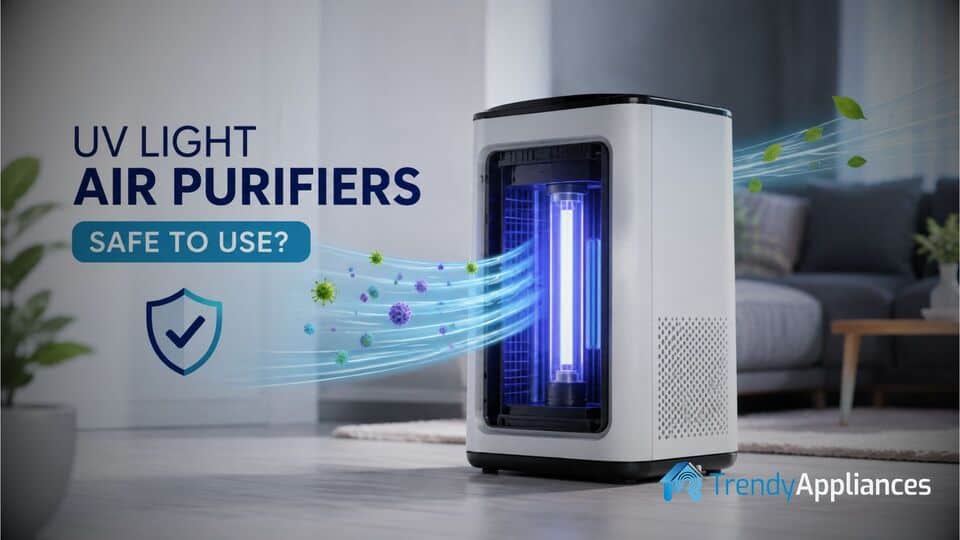
If you are wondering whether UV light air purifiers are safe and worth using, this guide will help you make an informed decision.
Clean indoor air is essential for a healthy and comfortable home. However, dust, smoke, pollen, mold spores, pet dander, bacteria, and other airborne contaminants can reduce indoor air quality. Air purifiers can help control some of these pollutants, but not every purification technology works in the same way.
Some air purifiers include ultraviolet light, particularly UV-C light, to inactivate certain microorganisms. This raises an important question: Are UV light air purifiers safe?
A properly designed UV-C air purifier can generally be used safely when its ultraviolet lamp is fully enclosed and the device does not produce harmful amounts of ozone. However, UV light should normally be treated as a supplementary feature rather than a replacement for effective particle filtration.
How Do UV Light Air Purifiers Work?
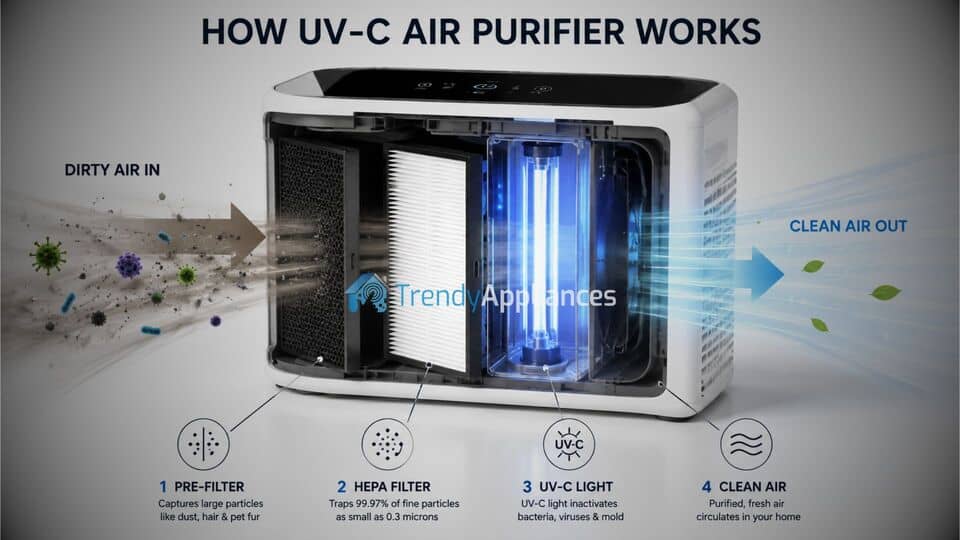
UV light air purifiers use short-wavelength ultraviolet energy to inactivate certain microorganisms, including some bacteria, viruses, and mold spores. This process is commonly known as ultraviolet germicidal irradiation, or UVGI.
Inside an enclosed air purifier, a fan draws room air into the unit. The air passes through a chamber containing one or more UV-C lamps. When microorganisms receive a sufficient UV dose, the radiation damages their genetic material and reduces their ability to reproduce or remain infectious.
The effectiveness of this process depends on several factors, including:
- The intensity and wavelength of the UV-C lamp
- The amount of time microorganisms remain exposed
- The distance between the lamp and the airflow
- The purifier’s airflow speed
- The type and resistance of the microorganism
- The cleanliness and condition of the UV lamp
Simply placing a small UV lamp inside an air purifier does not guarantee effective disinfection. Air may move through the chamber too quickly to receive a sufficient UV dose, particularly in inexpensive or poorly designed units.
Different Types of UV Light
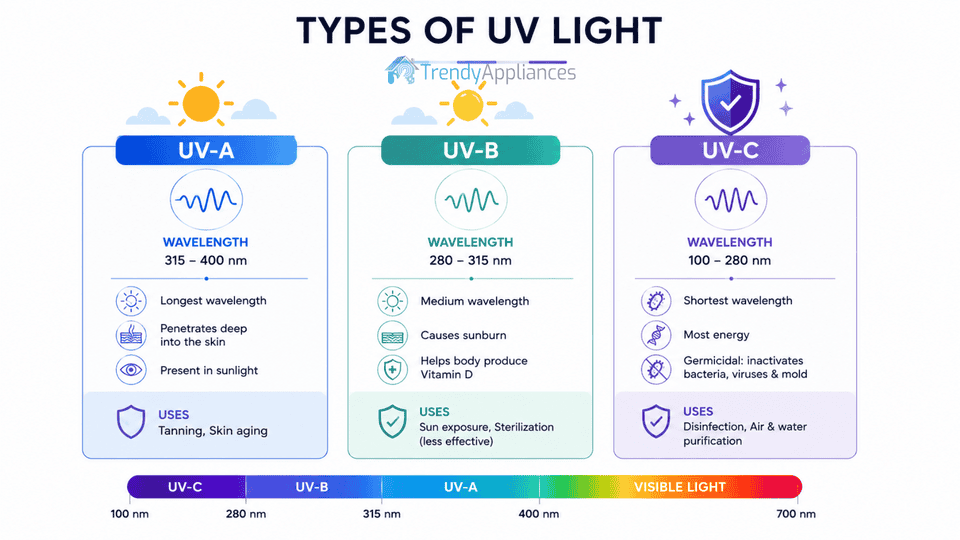
Ultraviolet radiation is generally divided into three main categories:
- UV-A
- UV-B
- UV-C
UV-A
UV-A has the longest wavelength of the three categories. It is present in natural sunlight and can penetrate deeper into the skin. Long-term exposure contributes to premature skin aging and can increase the risk of skin damage.
UV-B
UV-B has a shorter wavelength and more energy than UV-A. It is strongly associated with sunburn and can damage the skin and eyes after excessive exposure.
UV-C
UV-C has shorter wavelengths than UV-A and UV-B and is commonly used for germicidal applications. Most natural UV-C radiation from the sun is absorbed by Earth’s atmosphere, but artificial UV-C lamps can produce it for air, water, and surface disinfection.
Direct exposure to conventional UV-C light can injure the eyes and skin. For this reason, the UV lamp inside a residential air purifier should remain completely enclosed while the purifier is operating.
How Does UV-C Light Purify the Air?
UV-C light does not filter particles from the air in the same way as a HEPA filter. Instead, it attempts to inactivate susceptible microorganisms by damaging their DNA or RNA.
When air enters the purifier, larger particles may first pass through a pre-filter. A HEPA filter can then capture fine airborne particles, including dust, pollen, pet dander, smoke particles, and many microorganisms carried on droplets or other particles.
If the purifier also contains a UV-C chamber, the lamp may expose captured or passing microorganisms to germicidal ultraviolet energy. Depending on the UV dose, this exposure can reduce the microorganisms’ ability to reproduce.
This is why UV-C generally works best as part of a multi-stage system rather than as a stand-alone purification method.
Are UV Light Air Purifiers Safe?
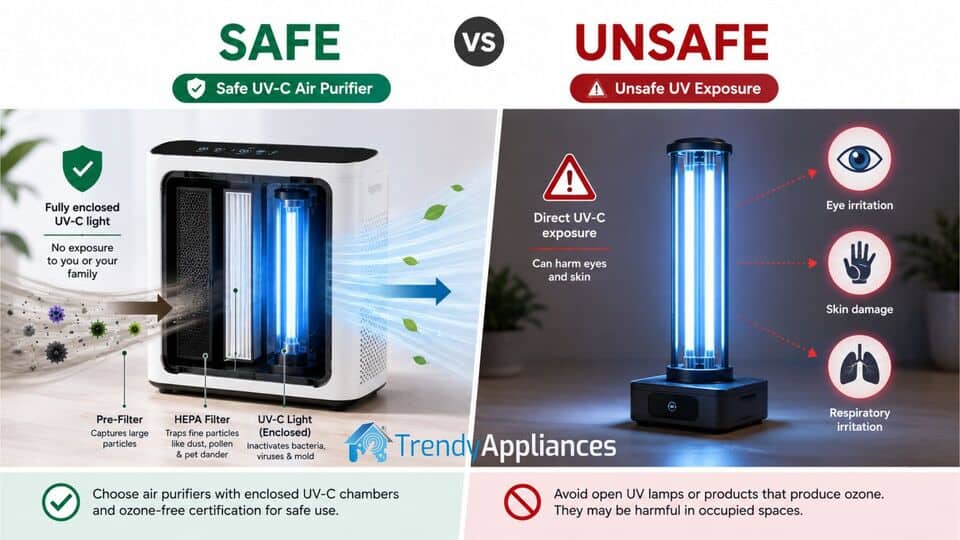
UV light air purifiers can be safe when they are correctly designed, properly maintained, and used according to the manufacturer’s instructions.
A safe residential design should keep the UV-C lamp inside a sealed chamber so that people and pets cannot look directly at it or expose their skin to it. The enclosure should remain closed during operation, and the purifier should automatically switch off the UV lamp if an access panel is opened.
However, safety can vary considerably between models. The two main concerns are accidental UV-C exposure and ozone production.
Risk of Direct UV-C Exposure
Direct exposure to conventional UV-C radiation can cause painful eye irritation and skin injury. You should never operate a purifier with its cover removed, look directly at an illuminated UV-C lamp, or attempt to bypass a safety switch.
UV-C bulbs should only be inspected or replaced after the purifier has been switched off and unplugged. Follow the manufacturer’s replacement procedure carefully.
Risk of Ozone Production
Some ultraviolet lamps and electronic air-cleaning technologies can produce ozone. Ozone is a reactive gas that can irritate the lungs, throat, nose, and breathing passages. It can be particularly problematic for people with asthma, allergies, or other respiratory sensitivities.
Not every UV-C purifier produces a meaningful amount of ozone. Ozone generation depends partly on the lamp’s wavelength, construction, and the other technologies used inside the purifier.
When comparing products, look for a model that is explicitly described as ozone-free and has been tested by a reputable independent organization. Avoid products that intentionally generate ozone or advertise ozone as the primary method of cleaning occupied indoor spaces.
Can UV Air Purifiers Cause Cancer?
Direct and repeated exposure to ultraviolet radiation can damage human tissue. However, a correctly manufactured air purifier should prevent occupants from being exposed to its UV-C lamp.
The ultraviolet light remains inside the appliance and treats air as it passes through an enclosed chamber. Under normal operating conditions, you should not be exposed to the lamp.
The risk increases when a device is damaged, poorly constructed, operated with its casing open, or used in a way that exposes the eyes or skin. This is why you should not modify a UV purifier, disable its safety mechanisms, or use a bare UV-C lamp as a room air cleaner.
Are UV Air Purifiers Safe for Babies and Children?
An enclosed, ozone-free UV air purifier may be used in a home with children when the manufacturer states that it is suitable for occupied residential spaces. However, the unit should be placed where children cannot open, tip over, or tamper with it.
For a nursery or child’s bedroom, prioritize a purifier with:
- A true HEPA or comparably effective particle filter
- No intentional ozone generation
- A fully enclosed UV-C lamp
- A child lock or tamper-resistant controls
- A stable base
- A quiet sleep mode
- A suitable clean air delivery rate for the room
Parents should not rely on UV-C alone to remove dust, smoke, pollen, or other common indoor particles.
Are UV Air Purifiers Safe for Pets?
Properly enclosed UV-C purifiers are generally designed to prevent direct exposure to occupants, including household pets. Nevertheless, ozone-producing devices may irritate the respiratory systems of both people and animals.
Birds can be especially sensitive to airborne contaminants and fumes. Pet owners should therefore choose an ozone-free purifier, follow all manufacturer instructions, and discontinue use if the unit produces an unusual chemical or electrical smell.
Do UV Air Purifiers Remove Dust?
No. UV-C light does not physically remove dust from indoor air.
Dust, pollen, pet hair, pet dander, and smoke particles must be captured by a mechanical filter. A UV-only purifier may circulate air without meaningfully reducing these particles.
For everyday home use, a purifier with a correctly sized HEPA filter is usually more important than one with a UV lamp.
Do UV Air Purifiers Remove Mold?
UV-C may inactivate some airborne mold spores if they receive a sufficient dose. However, it does not remove existing mold growth from walls, ceilings, carpets, furniture, or HVAC components.
It also does not solve the moisture problem that allowed mold to grow. If your home has visible mold, you must locate and control the source of moisture, repair leaks, improve ventilation, and clean or remove contaminated materials safely.
A HEPA filter may capture airborne mold spores, while UV-C may provide an additional level of treatment. Neither feature replaces proper mold remediation.
Do UV Air Purifiers Kill Viruses and Bacteria?
UV-C can inactivate many bacteria and viruses under controlled conditions. However, a household purifier’s real-world performance depends on whether it provides enough UV intensity and exposure time.
Microorganisms moving rapidly through a small UV chamber may not receive a sufficient dose. Claims such as “kills 99.9% of germs” should therefore be examined carefully. Check whether the claim is based on independent testing of the complete purifier at its normal airflow settings rather than testing of the lamp alone.
Air purification can help reduce airborne contaminants, but it cannot guarantee that no one will become sick. Good ventilation, source control, cleaning, hygiene, and other appropriate health measures remain important.
UV-C Air Purifiers vs. HEPA Air Purifiers
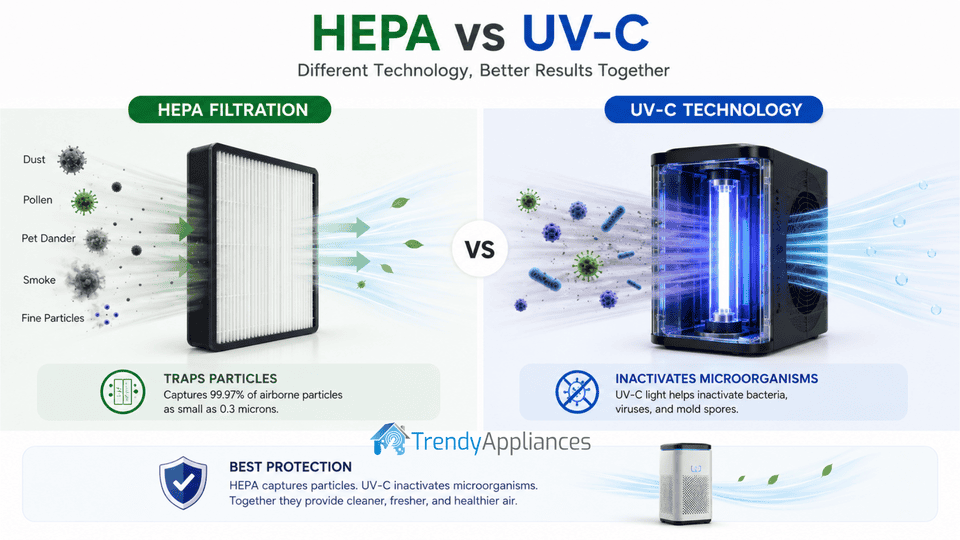
UV-C and HEPA technologies perform different tasks.
| Feature | UV-C | HEPA Filtration |
|---|---|---|
| Captures dust | No | Yes |
| Captures pollen | No | Yes |
| Captures pet dander | No | Yes |
| Captures fine particles | No | Yes |
| May inactivate microorganisms | Yes, with sufficient UV dose | Primarily captures them |
| May create ozone | Some designs can | Mechanical HEPA filters do not |
| Requires lamp replacement | Usually | No lamp, but filters require replacement |
For most households, a well-sized HEPA air purifier should be the starting point. UV-C can be considered an additional feature when the purifier has a safe enclosed design and credible performance testing.
Advantages of UV Light Air Purifiers
A well-designed UV-C purifier may provide several benefits:
- It may inactivate certain airborne microorganisms.
- It can supplement mechanical filtration.
- It may help control microbial growth on internal HVAC components or filter surfaces.
- It operates without adding liquid disinfectants to the air.
- An enclosed system can run while the room is occupied.
These benefits depend heavily on the quality and design of the device.
Disadvantages of UV Light Air Purifiers
UV-C purification also has important limitations:
- It does not capture dust, pollen, pet dander, or smoke particles.
- Effectiveness depends on UV intensity and exposure time.
- Some models may produce ozone.
- Direct UV-C exposure can harm the eyes and skin.
- UV lamps lose output over time and require replacement.
- Dust buildup on the lamp can reduce effectiveness.
- Replacement bulbs increase ongoing ownership costs.
- Some products make performance claims without sufficient independent testing.
Should You Use a UV Light Air Purifier?
You may consider a UV light air purifier when it combines UV-C with effective mechanical filtration and meets appropriate safety requirements.
A UV-C model may be suitable when:
- The lamp is completely enclosed.
- The purifier is explicitly ozone-free or meets recognized low-ozone requirements.
- It includes a high-quality particle filter.
- The manufacturer provides credible independent testing.
- The unit is correctly sized for your room.
- Replacement filters and UV bulbs are readily available.
You may want to avoid a particular model when:
- It intentionally generates ozone.
- The UV lamp is visible or accessible during operation.
- The manufacturer does not disclose its filtration specifications.
- It relies entirely on UV light without an effective particle filter.
- Its germ-killing claims are vague or unsupported.
- It produces a strong chemical, metallic, or electrical odor.
How to Choose a Safe UV Air Purifier
1. Prioritize Mechanical Filtration
Choose a purifier with a high-quality particle filter. UV-C should be a secondary feature rather than the purifier’s only cleaning technology.
2. Confirm That It Is Ozone-Free
Read the specifications carefully. Avoid vague descriptions such as “activated oxygen,” “energized oxygen,” or “air revitalization” when they refer to intentional ozone generation.
3. Check the Room Coverage
Choose a purifier that can process the air in your room several times per hour. Do not rely only on the manufacturer’s maximum room-size claim. Look at its clean air delivery rate and the airflow delivered at a noise level you can comfortably tolerate.
4. Look for Independent Testing
Independent safety and performance testing is more valuable than unsupported marketing claims. Check whether the entire appliance was tested, not merely an individual filter or UV bulb.
5. Check the UV Chamber Design
The UV-C lamp should be fully enclosed. The purifier should also include an automatic shutoff or interlock that disables the lamp when its service panel is opened.
6. Review Replacement Costs
Check the cost and availability of both replacement filters and UV bulbs. A purifier may become ineffective if its lamp is not replaced at the required interval.
7. Consider Noise and Energy Use
The purifier must move enough air to be useful. Select a unit that can run continuously at a comfortable noise level, especially when it will be used in a bedroom or home office.
How to Use a UV Air Purifier Safely
- Read and follow the manufacturer’s instructions.
- Keep the purifier’s casing closed during operation.
- Never look directly at an illuminated UV-C bulb.
- Unplug the purifier before cleaning or servicing it.
- Do not bypass door switches or safety interlocks.
- Replace the UV lamp according to the recommended schedule.
- Clean the pre-filter and replace the main filter as directed.
- Keep the air intake and outlet unobstructed.
- Stop using the unit if its enclosure becomes damaged.
- Discontinue use if it produces an unusual odor or causes respiratory irritation.
How Often Should You Replace the UV-C Bulb?
The replacement interval varies by purifier and lamp type. Some manufacturers recommend replacing the UV-C bulb approximately once a year, while other lamps may have shorter or longer rated service lives.
A bulb may continue to glow even after its germicidal output has weakened. You should therefore follow the manufacturer’s replacement schedule instead of judging the bulb only by whether visible light is present.
Some UV lamps contain mercury and require special disposal. Check your local regulations and the manufacturer’s guidance before throwing a used bulb into household waste.
Frequently Asked Questions
Can I Leave a UV Air Purifier Running All Night?
You can generally leave a properly designed, enclosed, ozone-free purifier running overnight if the manufacturer approves continuous operation. Use a lower fan speed or sleep mode when noise is a concern.
Can You See UV-C Light?
UV-C radiation itself is outside the range of normal human vision. Some lamps may produce a visible blue glow, but that glow does not indicate the strength or effectiveness of the germicidal UV output.
Does UV-C Remove Odors?
UV-C is not a reliable general-purpose odor remover. Activated carbon or another suitable gas-phase filter is usually more useful for reducing household odors and some gaseous pollutants.
Does UV-C Produce Ozone?
Some UV lamps can produce ozone, while properly designed ozone-free lamps are intended to minimize it. Always verify the specifications of the complete purifier before purchasing it.
Is a UV Air Purifier Better Than a Regular Air Purifier?
Not necessarily. A well-designed HEPA purifier without UV-C may provide better particle removal than a poorly designed UV purifier. The quality of the filter, airflow, room sizing, noise, and safety testing generally matter more than the presence of a UV lamp.
Can UV-C Replace Ventilation?
No. UV-C may supplement indoor air-quality measures, but it does not replace appropriate ventilation, pollutant source control, moisture management, or mechanical filtration.
Final Verdict: Are UV Light Air Purifiers Safe?
Yes, UV light air purifiers can be safe when the UV-C lamp is fully enclosed, the appliance is properly constructed, and the unit does not generate unsafe levels of ozone.
However, UV-C should not be treated as a complete air-cleaning solution. It does not physically remove dust, pollen, smoke, pet dander, or other particles. Its real-world germicidal performance also depends on the strength of the lamp, airflow, exposure time, and overall chamber design.
For most homes, choose a purifier primarily for its effective mechanical filtration, suitable clean air delivery rate, quiet operation, and appropriate room coverage. Consider UV-C an optional supplementary feature rather than the main reason to purchase the device.
Before buying, confirm that the model is ozone-free, independently tested, properly sized, and equipped with a completely enclosed UV-C chamber. Used correctly, such a purifier can add another layer of air treatment without unnecessarily exposing your household to ultraviolet radiation.